

Quick answer
Facebook lead forms (Meta instant forms) open inside Facebook or Instagram with contact details often prefilled, so they usually bring more leads at a lower cost per lead, but more of them never answer the phone. Landing pages cost more per lead but let you qualify, collect texting consent and track properly. For HVAC replacements, judge both on cost per booked estimate.
What is the difference between Facebook lead forms and landing pages?
A Facebook lead form, which Meta calls an instant form, opens inside Facebook or Instagram, often with the person's contact details already filled in. A landing page is a page on your own domain that the ad sends people to. Forms are quicker to submit. Landing pages give you more control over what happens next.
I write the offers and buy the ads at Scale Theory, and this is one of the first decisions on any Meta account. We are new to the US market and have no HVAC client results yet, so this post sets out how each option works according to Meta's own help pages, what each one costs you in time and money, and the setup we use.
One definition first. A booked estimate is a qualified homeowner booked for an in-home estimate on your calendar, at a set time. That is the number this whole comparison turns on.
How do Meta instant forms work?
When someone taps a lead ad, a form opens without leaving the app. Meta says contact information "may be prefilled" if the person has already given it to Meta. You choose a form type, add up to 15 custom questions, link a privacy policy and write the message they see after submitting.
Meta lists three form types:
- More volume (the default): built to be "quick to fill out and submit on a mobile device".
- Higher intent: adds "inline context under contact fields" to say your business may follow up, and "an additional review screen" so people confirm their details before submitting. Meta says this form type is only delivered to Facebook and Instagram feeds on mobile, not desktop.
- Rich creative: lets you add images, colors and extra text to give more context.
Custom questions can be multiple choice, short answer, conditional, store locator or appointment request. Meta also offers conditional logic, which changes the next question based on an answer, and an option to require SMS verification by one-time code before the form submits, if phone number is a required field.
That is a lot of qualifying power, and most HVAC accounts I audit use none of it: a more volume form with name, phone and email, and nothing else.
Why do instant forms often bring weaker HVAC leads?
Because the easier a form is to submit, the more people submit it without meaning much by it. Prefilled details mean a homeowner can tap through in seconds while scrolling. For a $50 product that is fine. For a system replacement, every lead that does not pick up still costs your CSR several calls.
The usual complaints I hear about instant form leads: "they don't remember filling it in", "wrong number", "they wanted a repair", "they're renting". None of that is fraud. It is what happens when the form asks for nothing beyond contact details.
You can push back on it inside Meta:
- Use the higher intent form type, so there is a review step.
- Add multiple choice questions that sort people: replacement or repair, system age, timing, homeowner or renter.
- Turn on SMS verification to cut wrong numbers.
- Write the intro so it is clear this is a request for an in-home estimate, not a price list.
Each of those costs you some volume. That is the point. You want fewer, better leads.

What does a landing page do better?
A landing page lets you set the pace. The homeowner reads the offer, sees local reviews and photos of your installs, then answers tap-to-answer questions before giving a phone number. You also control the consent wording, the tracking and exactly where the answers go in your CRM.
Here is how the two compare on the things that matter for HVAC:
| Instant form (more volume) | Instant form (higher intent) | Landing page with qualifier | |
|---|---|---|---|
| Where it opens | Inside Facebook or Instagram | Inside Facebook or Instagram, mobile feeds only | Your domain |
| Contact details | Can be prefilled | Can be prefilled, with a review screen | Typed in |
| Qualifying questions | Up to 15 custom questions | Up to 15 custom questions | As many steps as you build |
| Room to show reviews and job photos | Limited | Limited | Full page |
| Texting consent | Custom disclaimer with checkboxes | Custom disclaimer with checkboxes | Your own wording next to the phone field |
| Getting leads into a CRM | Integration, connector or download | Integration, connector or download | Straight from the page |
| Cost per lead | Usually lowest | Higher | Usually highest |
The last row is the one people fixate on, and it is the least useful.
How do you collect consent to text leads from each one?
Both can do it. On an instant form, add a custom disclaimer with a checkbox. On a landing page, put the consent line next to the phone field. Either way, for automated marketing texts the federal rule requires prior express written consent. This is general information, not legal advice.
Meta says a custom disclaimer is "any legal notice or consent disclaimer" and can include checkboxes, which you can mark as optional. Meta also says that when you add a disclaimer, "people are required to agree to submit the form", so read the wording carefully before you publish. A form already running in an ad cannot have a disclaimer added; you duplicate the form and add it there.
The rule is 47 CFR 64.1200, the FCC regulation under the Telephone Consumer Protection Act. For advertising or telemarketing texts sent with an autodialer, it requires the "prior express written consent of the called party". The written agreement has to make clear the person is not required to sign "as a condition of purchasing any property, goods, or services". Opt-outs such as replying "stop" must be honored "within a reasonable time not to exceed ten business days".
In practice: the consent checkbox should name your business, say what kind of messages they will get, and say it is not a condition of buying. Keep a record of it in the CRM with the lead. State rules can add more, so have your attorney approve the wording on both setups. Our post on HVAC lead follow-up shows what those texts look like.
How do instant form leads get into your CRM?
Through a direct integration, a third-party connector such as Zapier, or a custom integration using Meta's webhooks and API. Without one, you download a file. Meta says leads can only be downloaded for 90 days after someone submits the form, so set up the connection before the first ad goes live.
Speed matters more than the method. A lead that sits in Meta until someone downloads a file on Monday has usually booked with someone else. Whichever route you choose, test it: submit a test lead, and confirm it lands in the CRM with every answer mapped to a field and the consent record attached.
There is a second reason to connect the CRM. Meta's qualified leads and conversion leads goals let you send lead stages from your CRM back to Meta, so delivery can lean toward people who become customers. That only works if your team updates the stage when an estimate is booked, sold or lost.
Which is cheaper: instant forms or landing pages?
Instant forms are usually cheaper per lead. Whether they are cheaper per booked estimate depends on how many of those leads qualify and book. Run both through the same math and the answer often flips. Use your own data, but here is the shape of it.
Worked example: $2,500 of Meta spend, two setups (planning assumptions)
Instant form: $2,500 / $60 assumed cost per lead = about 42 leads
42 x 35% assumed qualified = about 15 qualified; 15 x 50% assumed booked = about 7 booked estimates
Instant form ad cost per booked estimate: $2,500 / 7.3 = about $340
Landing page with qualifier: $2,500 / $110 assumed cost per lead = about 23 leads
23 x 60% assumed qualified = about 14 qualified; 14 x 60% assumed booked = about 8 booked estimates
Landing page ad cost per booked estimate: $2,500 / 8.2 = about $305
Break-even: the instant form matches the landing page when (qualified rate x booking rate) reaches 36% x ($60 / $110) = about 19.6%. At a 50% booking rate, that means about 39% of instant form leads have to qualify.
Every cost per lead and rate above is a planning assumption, not a benchmark or client result.
The example leaves out labor. At these assumptions your CSR or VA works about 42 instant form leads to book 7, against about 23 landing page leads to book 8. If each new lead takes 10 minutes across calls and texts, that is about 7 hours against about 4 hours a month. Our post on HVAC cost per lead explains why cost per lead alone misleads.
What approach do we use for HVAC replacement leads?
We send Meta traffic to a landing page for your service area, with a six-question qualifier before the phone number. Qualified homeowners get a text and a call inside 60 seconds and are booked onto your calendar. We judge every setup on cost per booked estimate, and test instant forms against it where the numbers justify it.
The six questions are home type, current system and its age, replacement or new install or repair, timing, budget range, and homeowner or renter. Name, cell and a consent box come last. Repair requests and renters never reach your calendar as a booked estimate, but they stay in the CRM tagged by answer, so you can see what was filtered.
Why not start with instant forms? Because the cost of a bad lead in HVAC replacement is not the $60. It is a comfort advisor driving to an apartment where the renter wanted a repair. If a higher intent instant form with the same six questions beats the landing page on cost per booked estimate in your market, we will use it. The full setup is on our Facebook ads for HVAC page, and the follow-up behind it is on HVAC CRM automation.
Does this change for Las Vegas HVAC contractors?
The comparison is the same. Two local facts change the questions you should ask: most Las Vegas homes heat with gas, so AC and furnace changeouts matter as much as heat pumps, and NV Energy's AC equipment incentives only cover single-family homes and townhomes, so home type has to be on the form.
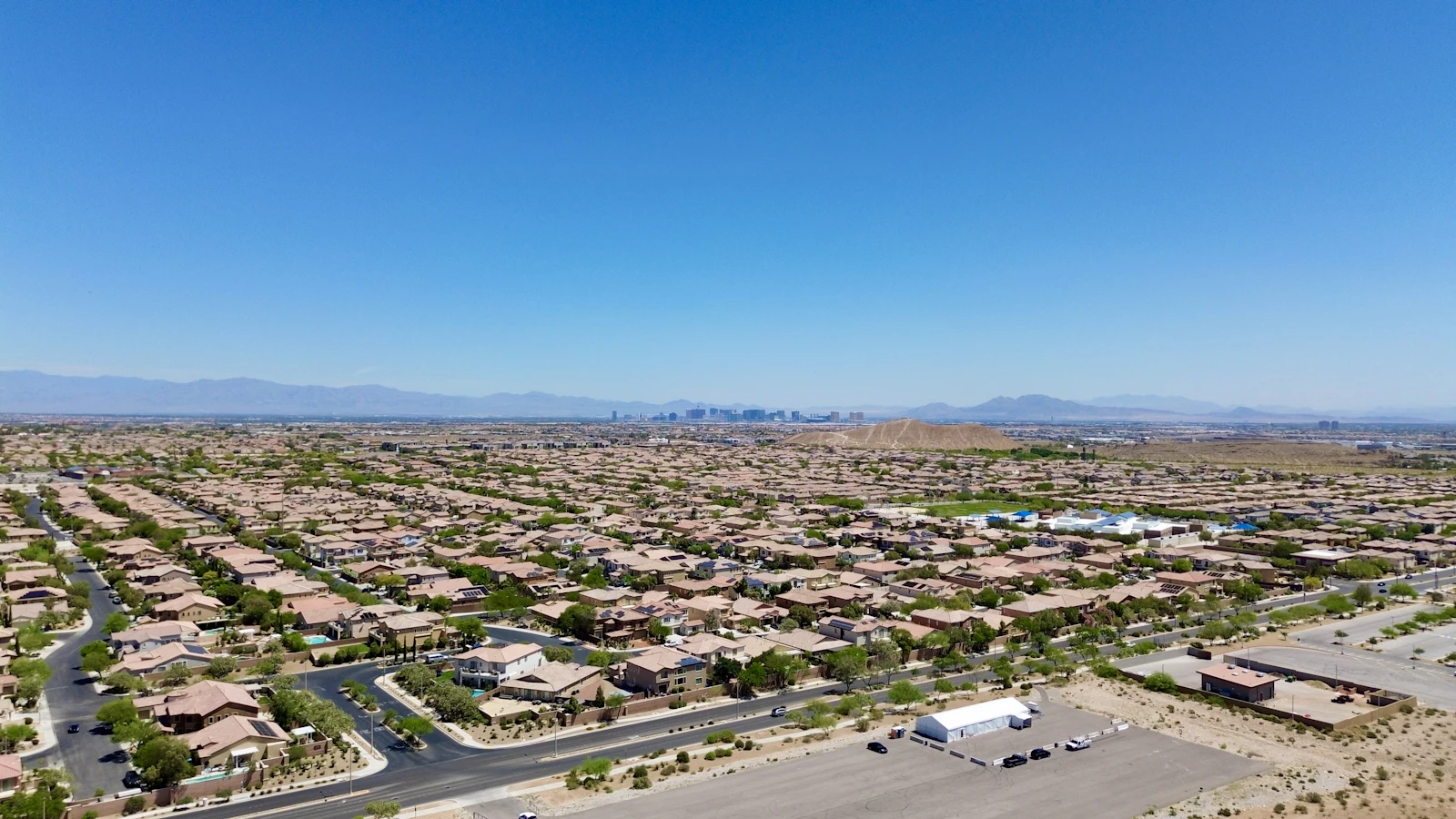
The heat is relentless. NOAA's 1991 to 2020 normals for Las Vegas Harry Reid International Airport show about 137 days a year at or above 90°F and about 78 days at or above 100°F, with an average summer high around 102°F and only about 4.2 inches of rain a year. Systems work hard, so a homeowner with a struggling 15-year-old unit in July wants a call back now. That makes the 60-second reply matter more than the form type.
Heating fuel leans to gas. The Census Bureau's 2024 American Community Survey shows about 63% of occupied homes in the Las Vegas-Henderson-North Las Vegas metro heat with utility gas and about 34% with electricity. Your qualifier should ask what system the home has now, so a gas furnace home gets the AC and furnace changeout conversation and an all-electric home gets the heat pump one.
On rebates: NV Energy's 2026 resource plan filing with the Public Utilities Commission of Nevada says its Residential HVAC and Heat Pumps program is "continuing to offer AC, heat pump, tune up and heat pump water heating incentives" in 2026. Incentives are paid "mid-stream" as instant rebates on the contractor's invoice. The home must be "a residential single-family home or town home", and "Multi-family units do not qualify". The filing shows a 2026 budget of $3,255,000 for this program in the Nevada Power (southern Nevada) territory. Funding can run out: Nevada Current reported that NV Energy ended its AC and heat pump replacement rebates on August 31, 2024 after "a high level of participation". We could not confirm current rebate amounts on NV Energy's own rebate pages, so check the current tiers with NV Energy before you put a number in an ad.
More on the market is on our Las Vegas HVAC marketing page. If you also serve Henderson, see our Henderson HVAC marketing page.
Sources
- About instant form types | Meta Business Help Center
- About lead ads with instant form | Meta Business Help Center
- Create a lead ad with instant form in Meta Ads Manager | Meta Business Help Center
- Add custom questions to your lead ads with instant form | Meta Business Help Center
- Add a custom disclaimer to your lead ads with instant form | Meta Business Help Center
- About CRM system integrations for lead ads | Meta Business Help Center
- About expired leads | Meta Business Help Center
- Set up your CRM for qualified leads | Meta Business Help Center
- 47 CFR 64.1200, Delivery restrictions | eCFR
- 2027-2046 Integrated Resource Plan, Volume 33: Demand Side Management Plan | NV Energy filing with the Public Utilities Commission of Nevada
- NV Energy's on-again, off-again air conditioning rebates are off at month's end | Nevada Current
- Normals Annual/Seasonal 1991 to 2020, Las Vegas Harry Reid Intl AP (USW00023169) | NOAA NCEI
- American Community Survey 2024 1-year, table B25040 House Heating Fuel | U.S. Census Bureau

Sam
Sam runs every strategy call and buys every ad. Before going HVAC-only, he ran a performance marketing agency: SEO, Meta and Google ads, CRM automation.
More about Sam